

Why Shrinkage Testing Matters Before Bulk Production of Bed Sheet Sets?
Bed sheet sets may meet the required dimensions during sample approval or pre-shipment inspection, yet consumers may still find that fitted sheets no longer cover the mattress properly, quilt inserts bunch up inside their covers, or pillowcases become too tight after washing according to the care label instructions. We recommend confirming post-wash dimensions before bulk cutting, while the fabric and production methods can still be adjusted and the test results can be used directly as a basis for production approval.
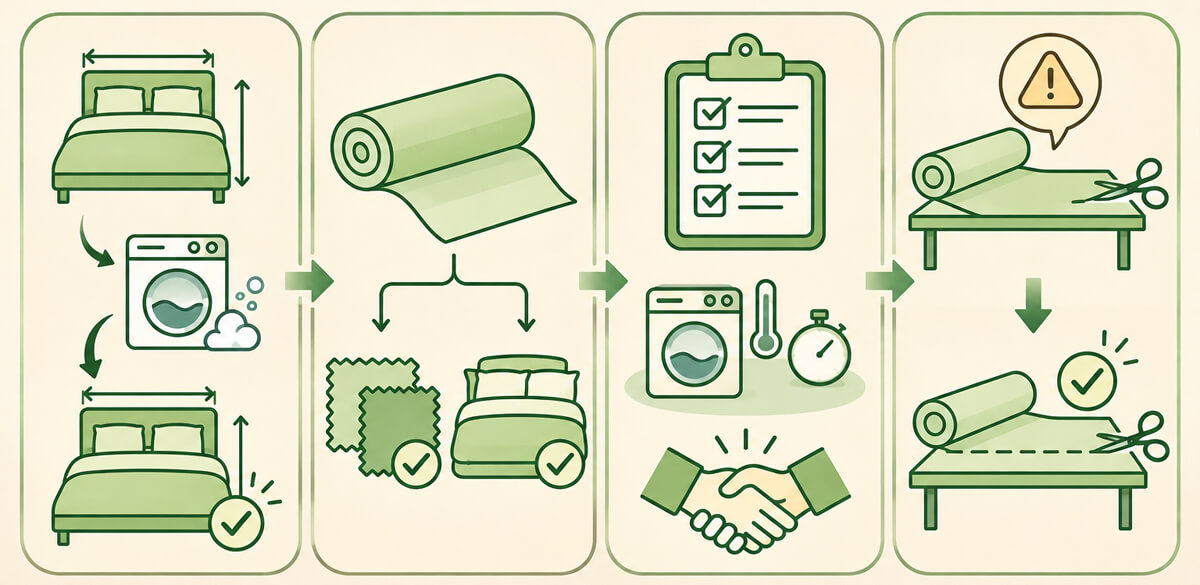
1. Verify Actual Fit Through Post-Wash Measurements
Fabric is subjected to tension during weaving, dyeing and finishing. After washing and drying, the degree of shrinkage may differ between the length and width. For example, a quilt cover measuring 240 cm in length before washing will become 7.2 cm shorter if it shrinks by 3%. If the original allowance is small, the quilt insert may easily bunch up inside the cover after washing.
Fitted sheet samples also need to be assessed against the intended mattress depth. If the product is designed to accommodate a mattress topper, its thickness should be included in the total depth. A post-wash fitting test should then confirm whether all four corners remain securely covered and the elastic holds the sheet firmly in place.
2. Test Fabric Swatches and Finished Products Using Bulk Production Fabric
Before production begins, representative swatches should be selected from the fabric intended for bulk production. Dimensional changes in the warp and weft directions should be recorded separately, with the corresponding dye lot or production batch identified in the test report.
Fabric swatch testing is used to assess dimensional stability, while finished product testing can identify issues arising from sewing construction, such as puckering around quilt cover openings or insufficient corner depth in fitted sheets.
If the production fabric changes to a different batch or the finishing process changes, new samples should be taken from the affected fabric, and the finished products should be reassessed based on the test results.
3. Agree on Testing Conditions and Acceptance Criteria When Placing an Order
The shrinkage rate of the same product can vary depending on the washing temperature, number of wash cycles and drying method used. Buyers and manufacturers should clearly specify the testing method, washing and drying conditions, measurement points for each component, and allowable dimensional changes in both length and width in the order specifications. Testing conditions should also be consistent with the care instructions intended for the final product.
The test report should include the sample and fabric batch details, actual measurements before and after washing, dimensional change rates and inspection results. For fitted sheets, separate requirements can also be agreed for the minimum effective pocket depth after washing or the fitting test. The report should record the sample number, fabric batch, actual measurements before and after washing, and inspection results so the buyer can verify the findings.
4. Address Deviations Before Cutting to Reduce Rework and Returns
If test results fall outside the agreed tolerances, the factory can review the fabric batch and finishing process, carry out pre-shrinking treatment or replace the fabric where necessary, and then repeat the tests under the original conditions.
If shrinkage is consistent and adjustments can meet both the required dimensions at delivery and post-wash fitting requirements, the cutting dimensions can also be adjusted with the buyer’s approval, followed by the preparation of a new pre-production sample.
Once the bulk fabric has been cut, there is less room for adjustment. If problems only become apparent after the goods arrive at the warehouse or have already been sold, buyers may also face costs associated with returns, after-sales service and disruption to their sales schedules.
# Conclusion
By making wash performance part of the pre-production approval criteria, buyers can verify three things before bulk production begins: whether the actual production fabric was used for testing, whether the washing and drying conditions match the care instructions, and whether the finished products remain suitable for use after washing. With documented evidence for all three, both parties can make an informed decision on whether to proceed with production.