

How Production Capacity and MOQ Actually Work Together in Sheet Set Manufacturing
If you’re sourcing bedding sets for markets like Australia, the US or Canada, you’ve probably come across two terms more than once: production capacity and MOQ (minimum order quantity).
At first glance, MOQ might seem like just a number — a simple starting point set by the factory. But in reality, there’s a lot more behind it.
From a factory’s point of view, MOQ isn’t just picked at random. It’s shaped by production efficiency, the level of customisation involved, how the supply chain is structured, and how the factory approaches long-term partnerships.
So how do production capacity and MOQ actually work together? Let’s walk through it.
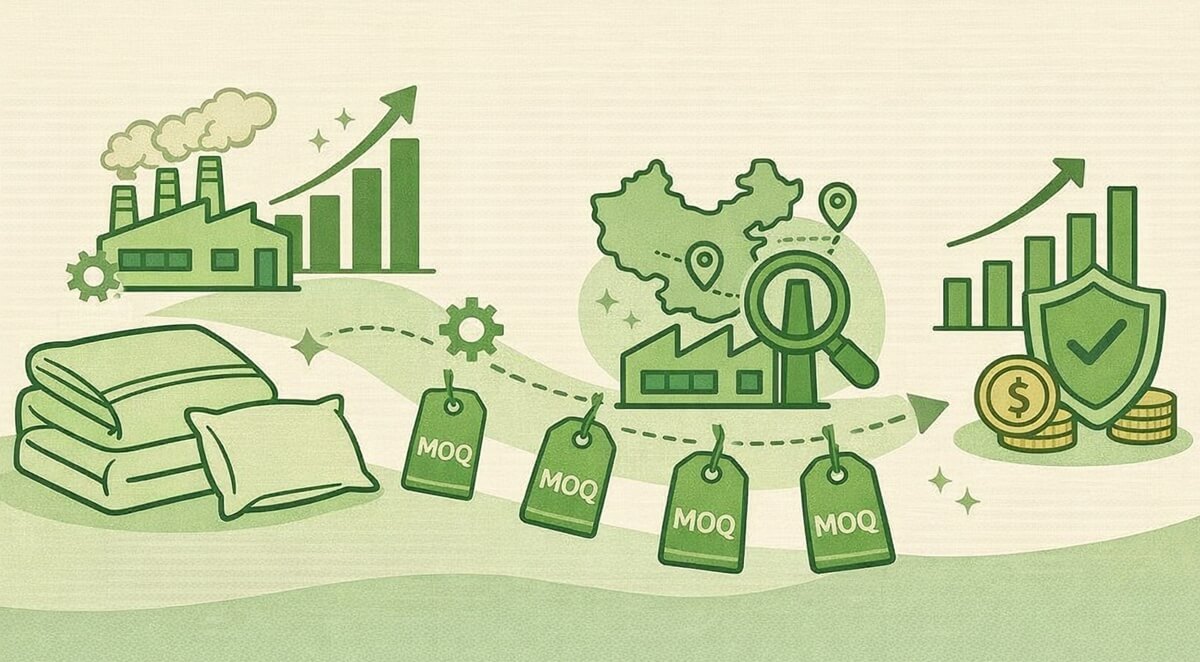
1.Production Setup Lays the Groundwork
Making a bed sheet set isn’t just about stitching fabric together. It’s a full process — from sourcing fabrics and cutting, right through to sewing, printing, embroidery, packaging, quality checks and final delivery.
So when we talk about production capacity, it’s not just about how many sets a factory can produce in a day. It’s really about how well they can organise production, keep things running smoothly, and deliver consistently over time.
Factories with more established systems usually have clearer and more stable MOQ ranges. That’s because their operations are built around batch production. Once order quantities reach a certain level, everything starts to run more efficiently — from cutting and sewing to packaging and material sourcing. That’s also when costs begin to make real sense.
That’s why many experienced export factories set MOQs around 100 or 200 sets, sometimes higher. It’s not about being rigid. It’s about making sure production runs efficiently and quality stays consistent.
From a buyer’s perspective, a factory with a well-defined MOQ often signals a more mature operation — one that can offer consistent quality, more predictable lead times, and a clearer cost structure over time.
2.The More Custom Your Product, the Higher the MOQ
MOQ is closely tied to how standard or customised your product is.
For more straightforward products — think plain colours, common fabrics like cotton or bamboo, standard sizing and simple packaging — factories can usually be more flexible. These types of products are easier to slot into existing production schedules, and materials are often readily available.
But once you move into custom designs, things shift quite quickly. Exclusive prints, custom dyeing, embroidery, higher thread count fabrics, branded labels, or tailored packaging all introduce additional steps before production even begins.
At that point, you’re no longer just placing an order — you’re effectively developing a product. That involves sampling, approvals, testing, and coordination across multiple suppliers.
What’s often overlooked is that every part of the supply chain comes with its own minimums. Fabric dyeing requires certain batch volumes. Printing has minimum run sizes. Packaging and labels also come with baseline quantities. So the MOQ you see at the final product level is actually the result of all these moving parts working together.
In simple terms, the more standard your product is, the more flexible MOQ can be. The more tailored and detailed it becomes, the higher the MOQ tends to go.
3.Higher Capacity Doesn’t Mean Lower MOQ
It’s easy to assume that a factory with higher production capacity would be more willing to accept smaller orders. But in practice, that’s not always how it works.
Larger and more experienced factories usually have more structured systems in place, and with that comes a clearer and more defined MOQ approach.
Even a relatively small order still needs to go through the full process — materials need to be prepared, machines set up, production scheduled, and quality checks completed. When order quantities are too low, the time and cost involved in these setup stages become disproportionately high.
Because of this, professional factories don’t simply lower MOQ to secure orders. Instead, they set MOQ at a level that makes sense based on the product, the production process, and the overall workflow.
For buyers, this is often a positive sign. It shows the factory understands its own operations, has control over costs, and is set up for stable, scalable production. In the long run, that kind of consistency tends to matter more than short-term flexibility.
4.MOQ Also Reflects the Customer Relationship
In real-world sourcing, MOQ isn’t always fixed. It can shift depending on the customer and the nature of the collaboration.
For established wholesalers, retailers or brands with consistent order volumes, factories will usually stick to their standard MOQ. These types of customers typically have clear purchasing plans and reliable reorder cycles, which makes production easier to manage.
But for newer brands, startups, or buyers testing a market, factories often take a more flexible view. If there’s a clear product direction, a defined target market, and genuine long-term potential, some manufacturers are open to adjusting MOQ for the initial order.
In some cases, they may support smaller trial runs, assist with development, or accept tighter margins early on. The idea isn’t to maximise profit on the first order, but to build a relationship that can grow over time.
Helping a client enter the market successfully often leads to repeat orders, larger volumes, and more efficient production down the track. From a factory’s perspective, that long-term value can outweigh the limitations of a smaller starting order.
Conclusion
At the end of the day, production capacity and MOQ aren’t separate considerations — they’re closely connected.
If you’re sourcing bedding sets for markets like Australia or beyond, it’s worth looking beyond just the MOQ number. What really matters is how that number is built — how the factory runs its production, how your product is structured, and whether there’s a clear logic behind the MOQ being offered.
Because in the end, it’s not about chasing the lowest MOQ. It’s about finding the right balance between quality, cost, lead time, and long-term growth.