

How Bed Sheet Set Pricing Is Calculated: Fabric, Labor, Packaging & Freight Explained?
From a manufacturer’s point of view, the cost of a bedding set goes far beyond “a piece of fabric plus a bit of stitching”.
In reality, it’s made up of multiple layers — fabric, workmanship, labour, packaging, compliance, inland transport and international shipping all play a part. Understanding where these costs come from makes it much easier to assess whether a supplier’s pricing is reasonable, and helps build more stable, long-term sourcing relationships.
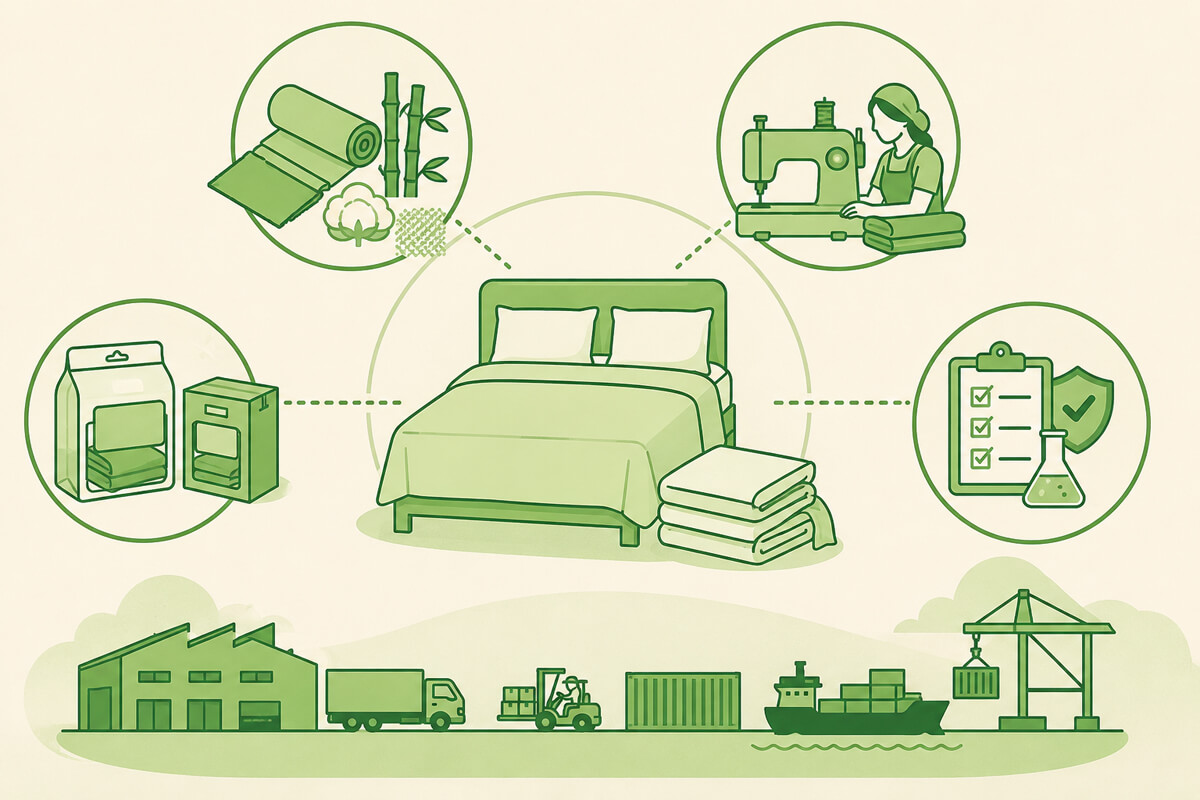
1.Fabric Is Where Most of the Cost Sits
Fabric is by far the largest cost component in a bedding set — and also one of the most commonly underestimated.
Buyers often look at finished sizes to estimate fabric usage. But from a factory’s perspective, it’s never that straightforward. Allowances need to be made for shrinkage, fabric width utilisation, and cutting loss.
Two bedding sets might look identical in size, but the cost can vary significantly depending on the fabric used. Higher thread count cotton, long-staple cotton, yarn-dyed fabrics, brushed finishes or bamboo blends all sit at very different price points. As a bamboo sheets manufacturer, we know firsthand how these materials affect cutting yield and final costing—so we build extra precision into our fabric planning. Even within cotton, variations in yarn count, density, weight, weave and finishing processes can shift the cost quite noticeably.
Another factor that’s often overlooked is what happens during finishing. Processes like bleaching, dyeing, pre-shrinking and heat setting all affect the fabric, and shrinkage is unavoidable. For example, it’s normal for cotton fabrics to shrink by 5%-8% after pre-shrinking, setting, and dyeing.
In simple terms, buyers see the finished dimensions — but manufacturers carry the real fabric consumption cost behind the scenes.
2.Labour and Workmanship Shape the Manufacturing Cost
Labour is the second major cost driver, and it’s closely tied to the level of detail required in production.
While bedding sets are a well-established product, expectations can vary quite a bit across different markets. Basic stitching is only one part of the process. Details like piping, panel joining, quilting, decorative stitching, embroidery, labelling, care tag attachment, and the installation of buttons or zippers all add time and complexity.
Once custom elements come into play — such as branded embroidery, special edging, woven labels or stricter stitching standards — production becomes more time-intensive. This often requires more experienced workers and tighter quality control, which naturally increases costs.
Order size also plays a role. Larger runs allow setup costs like sampling, machine adjustments and cutting layout to be spread across more units. Smaller, multi-style orders, on the other hand, tend to push the cost per set higher due to more frequent changeovers and less efficient production flow.
3.Packaging Is Part of the Product, Not Just Protection
For export markets like Australia, the US and Europe, packaging is no longer just about protecting the product — it’s part of how the product is presented and sold.
At the most basic level, packaging might be a simple PE bag with a label. But for retail brands, expectations are usually much higher. PVC zipper bags, non-woven bags, printed inserts, belly bands, colour cards, display boards or full retail boxes are all common.
Add to that barcodes, size labels, warning labels, sustainability claims, FSC-certified paper or recyclable packaging requirements, and the cost can increase quite quickly.
For many brands, packaging isn’t an add-on — it’s part of the product’s perceived value. That’s why manufacturers typically treat packaging as a separate cost component when building a quotation.
4.Logistics Completes the Cost Picture
For export orders, the cost doesn’t stop once production is finished.
Finished goods still need to move from the factory to a warehouse or port, which involves inland transport, handling, storage, customs clearance and documentation. If production is split across multiple facilities, additional consolidation and coordination costs can also come into play.
Once goods move into international shipping, factors like ocean freight rates, space availability, peak season surcharges and destination port fees all influence the final landed cost.
In recent years, freight costs have been particularly volatile. Because of this, many manufacturers separate product pricing from shipping costs in their quotations. It helps keep things transparent and avoids confusion when freight rates fluctuate.
5.Compliance and Testing Are Now Part of the Baseline
For markets like Australia, the US and Canada, compliance is becoming an increasingly important part of the overall cost structure.
Many buyers require testing for colour fastness, shrinkage, pilling, formaldehyde levels, azo dyes and flammability. Some brands also expect factories to meet social compliance standards, environmental audits or material certifications.
These costs may not be visible in the product itself, but they are real and need to be factored in. In many cases, a higher quote reflects not just the product, but the added layers of testing, documentation, traceability and quality assurance behind it.
# Conclusion
Fabric sets the foundation. Workmanship reflects the level of craftsmanship. Packaging shapes how the product is perceived. And logistics ensures everything arrives where it needs to be.
Understanding how these elements come together gives you a much clearer view of what goes into the price of a bedding set. More importantly, it helps both sides find the right balance between quality, lead time, packaging and cost — which is ultimately what makes a supply partnership sustainable over the long run.