

Hidden Costs in Bed Sheets Manufacturing What Importers Often Overlook
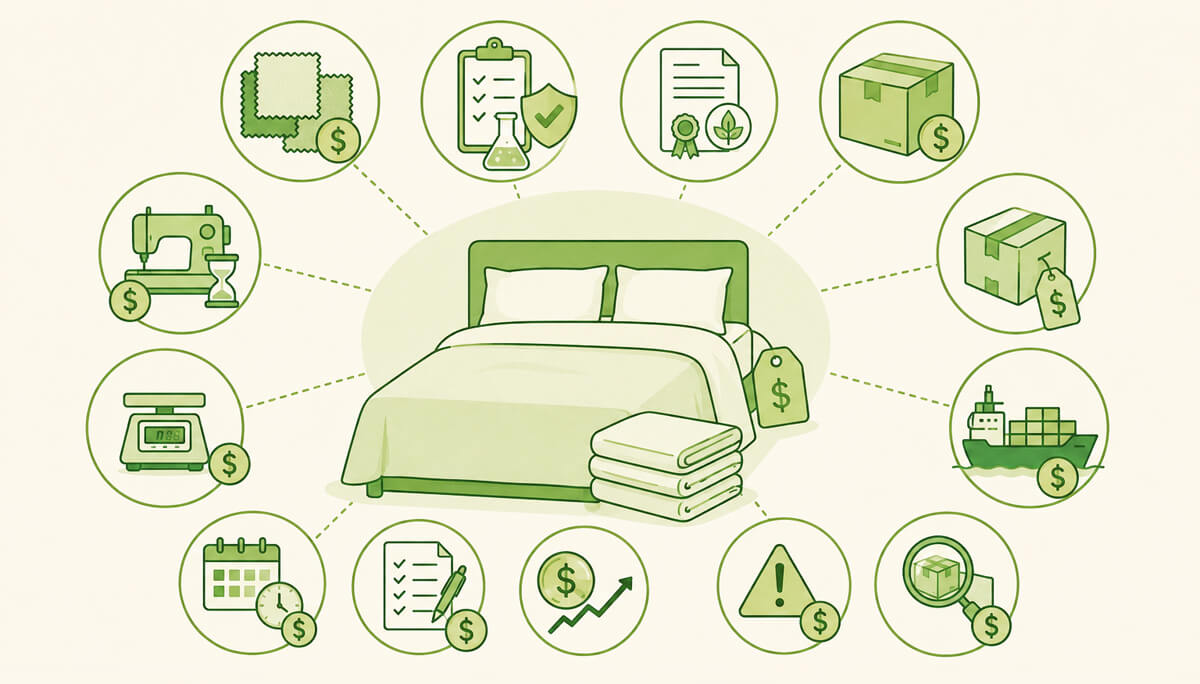
Based on industry experience, these hidden costs can increase your final landed cost by 15% to 30% compared with your initial estimate. From a manufacturer’s perspective, here are some of the most commonly overlooked costs that can affect your overall sourcing budget.
1.Pre-Production Costs Sampling, Testing and Certification
Many importers assume that sampling is free. In reality, most factories only provide the initial basic sample at no charge. Revised size samples, colour approval samples and packaging samples are usually charged separately, with costs typically ranging from $50 to $300 per sample. For more complex designs requiring multiple revisions, total sampling costs can easily reach several thousand dollars.
Testing and certification are another area that buyers often underestimate. The US and European markets have relatively strict requirements for textile safety, environmental compliance and labelling. Although certifications such as OEKO-TEX® Standard 100 are not mandatory for all bedding imports, many brands, retailers and sourcing programmes require them as part of their supplier approval or order acceptance process.
Depending on the product material, intended use and target market, buyers may also request testing for colour fastness, shrinkage, pilling, formaldehyde content and restricted azo dyes. These costs for testing, certification, corrective actions and re-testing are rarely included in an initial quotation, yet they can directly affect both the final purchase cost and production lead time.
2.Fabric Loss and Trims During Production
Fabric is the largest raw material cost in bedding manufacturing, but many buyers focus only on the fabric price and overlook actual material consumption.
Fabric loss mainly comes from three areas during production.
The first is shrinkage allowance. To ensure the finished bedding meets size specifications after washing, manufacturers need to allow for fabric shrinkage during production. The actual shrinkage rate depends on the fibre content, fabric construction and finishing process, with some fabrics approaching 10% under certain conditions.
The second is cutting efficiency. Products with engineered prints, stripes, checks, directional patterns or non-standard sizes often result in lower fabric utilisation.
The third is edge waste and fabric defects. Selvages, colour variation, holes and other fabric imperfections cannot be used in finished products.
As a result, the overall fabric loss rate may range from 10% to 25%. This does not mean that producing 100 sets only delivers 80 or 90 sets. It means the factory needs to purchase and consume more fabric than the theoretical requirement in order to produce 100 qualified bedding sets.
Trims can also create additional costs. Zippers, buttons, care labels and swing tags often come with supplier minimum order quantities that exceed the actual production volume. For example, you may need to pay for 10,000 custom buttons even though your current order only requires 3,000. The cost of the remaining inventory is often overlooked during the early quotation stage.
3.Logistics and Customs The Biggest Variable in Landed Cost
This is often where the largest hidden costs appear.
Many importers compare FOB prices without fully considering the costs incurred between the factory and the final warehouse. Ocean freight, fuel and peak season surcharges, port handling charges, customs brokerage, import duties, inspection fees, storage charges and last-mile delivery all contribute to the final landed cost.
One issue frequently encountered by home textile importers is incorrect HS code classification. Sheets, duvet covers, pillowcases and bedding sets are classified according to factors such as whether they are sold as a set, the fibre composition, the weaving method, and whether they are printed or embroidered. Different classifications may result in different duty rates and declaration requirements.
If the wrong HS code is declared, importers may face additional duties, customs delays, penalties or increased inspections on future shipments. For this reason, any HS code provided by the supplier should only be treated as a reference. The final classification should always be confirmed by the importer or customs broker in accordance with the regulations of the destination country.
Packaging volume is another cost that is often underestimated. For international courier services and air freight, carriers normally compare the actual weight with the volumetric weight and charge whichever is higher. For LCL sea freight, cargo volume also affects freight charges and some destination port fees. Bulky packaging can therefore increase shipping costs well beyond the original estimate.
If the required test reports, fibre composition documents or labelling information are not prepared in accordance with the contract or destination market requirements, shipments may also be delayed while additional documents are provided, products are re-tested, or labels are updated. In some cases, customers may even reject the shipment.
4.Compliance and Quality Control Costs That Shouldn’t Be Cut
Third-party pre-shipment inspections typically cost between $ 300 and $ 800 per inspection day, depending on the inspection company, location and scope of work. While this may seem like an extra expense, the cost of skipping an inspection is often much higher.
One Los Angeles brand decided to save $ 650 by skipping a pre-shipment inspection. After the goods arrived, they found that around 40% of the bedding sets had misaligned stripe patterns, resulting in losses of approximately $ 18,000. The lesson is simple identifying and resolving issues before shipment is usually far less expensive than dealing with returns, rework or claims after the goods reach their destination.
Product labelling is another area that should never be overlooked. The US, Europe and Australia all have different requirements for fibre content, country of origin, responsible supplier information and care instructions. In the United States, buyers generally focus on fibre content, country of origin and manufacturer or distributor identification. European markets place greater emphasis on fibre labelling and language requirements, while Australia requires care information to comply with applicable consumer product standards and market requirements.
Label materials, translation, printing and sewing all add to the overall cost. If any part of the labelling fails to meet customer or market requirements, additional documentation, relabelling, shipment delays or even order rejection may follow.
# Final Thoughts
Before placing an order, it’s worth asking your supplier about sampling charges, testing and certification requirements, estimated fabric loss, trim MOQs, packaging dimensions, inspection arrangements and the recommended HS code.
Experienced buyers don’t judge a quotation by the unit price alone. They understand the total cost of moving a product from the factory floor to the warehouse door.