

Bedding Set Sampling Process Explained: From Initial Samples to the Approved Samples
Samples are not only used to show how a product looks and feels. They also help assess whether the product can be produced consistently at the agreed cost, quantity and lead time. From initial sampling through to final approval, each review should address a specific issue and ultimately establish a clear production and inspection standard agreed by both the buyer and the factory.
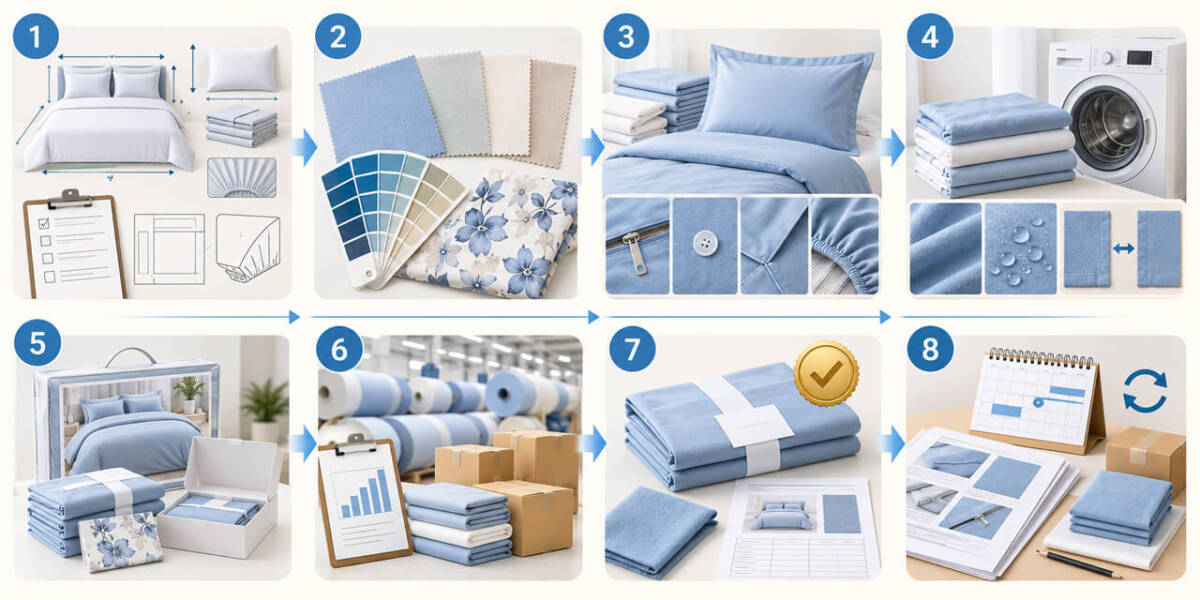
1.Confirm the Specifications
What makes up a bedding set can vary from market to market. Buyers should clearly specify the required combination of flat sheets, fitted sheets, duvet covers and pillowcases, along with the dimensions, fabric composition, yarn count and thread count, weave and workmanship requirements for each item.
For fitted sheets in particular, the mattress depth needs to be confirmed. Providing only a product photo or a size name such as “Queen” or “King” is not enough to establish an accurate production specification. Based on these details, the factory should prepare a sampling specification sheet for the buyer to confirm.
2. Fabric and Colour Samples
For custom-dyed solid colours, a Lab Dip is usually used for colour approval. Several options may be submitted and compared against the agreed physical colour standard under the specified lighting conditions.
For printed products, a Strike-Off is used to check colour matching, pattern scale, print clarity and repeat alignment. Samples should be made using the fabric base intended for bulk production and a representative production process.
Approval of the sample does not replace quality control during bulk production. Once the sample has been approved, colour and quality still need to be monitored throughout the production run.
3. Development Samples
Development samples are mainly used to check dimensions, sewing construction, duvet cover openings, pillowcase flanges, fitted-sheet elastic and other construction details. This stage can run alongside colour and print approval.
Samples made using substitute fabrics can be used to confirm certain construction details, but they should not be treated as the final reference for bulk colour, hand feel or performance after washing.
Buyers should consolidate their feedback, clearly noting the sample number and the exact area requiring adjustment. This helps avoid version confusion caused by multiple rounds of separate changes.
4. Wash Performance and Testing
Wash performance is an important part of bedding sampling. The buyer and factory should agree on washing and drying conditions, as well as the number of wash cycles, and then check dimensional changes, appearance and seam performance.
Depending on the product requirements, tests such as colour fastness and pilling may also be arranged. A product that meets the initial dimensions may not necessarily continue to fit the mattress or duvet insert after washing.
Test results should relate directly to the fabric and finishing process used for that product rather than simply relying on data from other products.
5. Sales Samples and Pre-Production Samples
Sales samples may be used for internal reviews, trade shows or marketing purposes. Whether they are required depends on the buyer and the project. They are not a necessary stage for every order and should not automatically be treated as the final approved sample.
Once the main issues have been resolved, the factory submits a PP Sample, or pre-production sample. This should be made using the fabric, trims, labels and production methods intended for bulk production, with the agreed packaging also presented where required.
If substitute materials are used or any changes are still outstanding, these should be clearly documented in writing, together with any re-sampling requirements and the scope of approval for production.
6. Confirm Production Capacity and MOQ at the Same Time
Production capacity and minimum order quantity should also be confirmed during the sampling stage.
A factory’s ability to make a small number of samples does not mean it can produce a small bulk order at the same unit cost. MOQ is often influenced by minimum quantities for weaving, dyeing, printing and custom packaging.
Buyers should confirm whether the MOQ applies by fabric, colour, print or style, and whether different sizes can be combined towards the minimum quantity.
If the required order volume falls below the standard MOQ, options such as using stock fabric, standard packaging or combining material requirements can be discussed. Pricing, production scheduling and lead times should then be reconfirmed accordingly.
7. The Approved Sample
The final approved PP Sample can become the Approved Sample.
Both the buyer and the factory should retain matching samples, with the sample number, version and approval date clearly recorded. The Approved Sample should be used together with the final specification sheet, dimensional tolerances, testing requirements and approval records as the basis for production and inspection.
If there is any difference between the physical sample and the written specifications, this should be clarified before bulk production begins.
Any later change to the fabric, construction or dimensions should be reassessed and approved before being introduced into production.
8. Revision Management and Sampling Lead Time
Each round of samples should be clearly numbered. Revision comments should ideally be provided in writing, supported by photos where useful, and consolidated into a single round of feedback.
Sampling lead times depend on material preparation, custom dyeing or printing requirements, testing arrangements, the number of revision rounds and shipping time. The factory should confirm the timeline based on the specific order.
It should also be clear when the sampling lead time begins and whether it includes shipping and buyer review time. This avoids confusing the time required to make a single sample with the full sample approval cycle.
Conclusion
An effective sampling process should ultimately establish a production standard that both the buyer and factory understand and can follow. The clearer the requirements are at the beginning, the stronger the basis for bulk production, quality inspection and final delivery.