

How to Check Bed Sheet Set Sample Measurements and Tolerances: A Manufacturer’s Guide
As a bed sheet set manufacturer with 10 years of experience, we’ve found that measurement disputes often come down to unclear measurement basis or standards when working with wholesalers and brand buyers across Europe, the US, Canada and Australia.
Accurate sample checking starts with both the buyer and manufacturer agreeing on the specifications, measuring methods and acceptance criteria before checking how well the products actually fit. During sampling, manufacturers should provide a specification sheet, measurement diagrams and key control requirements. Buyers should then check each item against the agreed criteria rather than relying on experience or visual judgement alone.
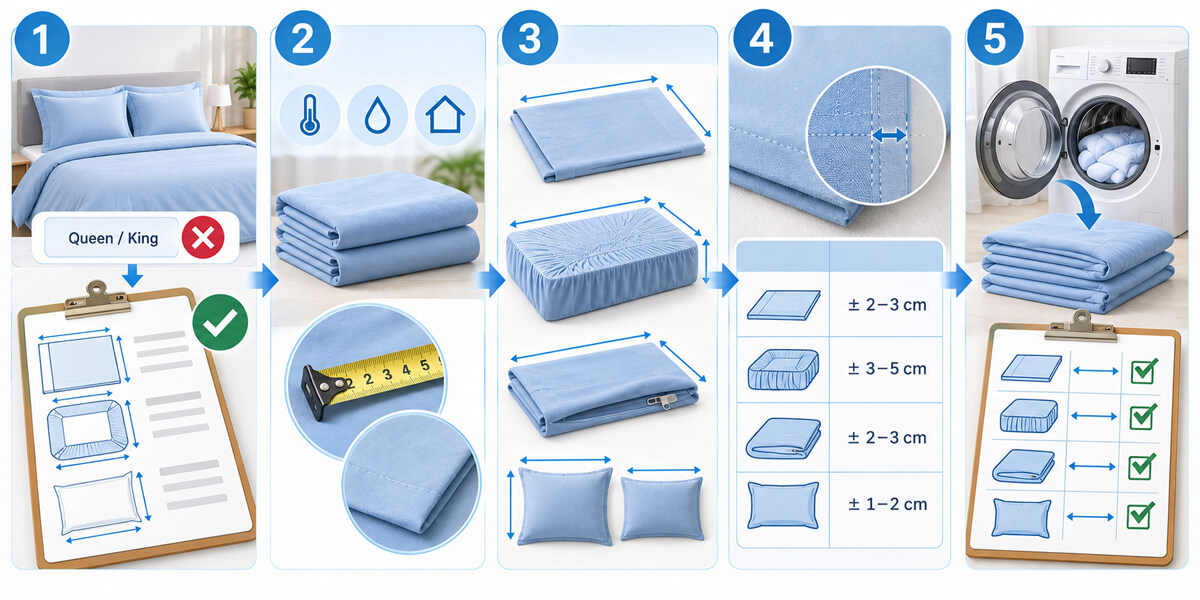
1. Confirm the Measurements, Not Just the Size Names
Bed sheet set combinations and size definitions vary between countries and brands. Buyers should confirm the product combination, quantity and finished dimensions of each flat sheet, fitted sheet, duvet cover and pillowcase rather than ordering based on size names such as “Queen” or “King” alone.
The size chart should also distinguish between the dimensions of the items to be fitted, the finished product dimensions and the cutting dimensions.
Mattress length, width and depth determine how a fitted sheet should fit, while duvet insert and pillow insert dimensions determine the required fit of duvet covers and pillowcases. These measurements should not be used directly as the finished dimensions of the sewn products.
Cutting dimensions need to account for seam allowances, hems and shrinkage allowances, which should be calculated separately by the factory. We recommend including the specification version number, measurement units, measurement diagrams, fabric shrinkage rate and seam and hem allowance details in the specification sheet so both parties can check the measurements consistently.
2. Use Consistent Measuring Conditions
After unpacking a sample, allow it to fully unfold and recover from any creasing or compression caused by folding and packaging.
When measuring, lay the product flat on a sufficiently large, level surface. Smooth out any wrinkles gently without stretching the fabric, and use a measuring tool with clear markings. It is worth agreeing on the measuring precision, such as 1 mm, and recording units, whether centimetres or inches, to avoid discrepancies caused by unit conversions.
Both parties should use the same units and agree on the exact starting and finishing points for each measurement, including whether decorative borders are included.
For products that can easily lose their shape, measurements can be taken at several agreed points, with each result recorded separately. This prevents an average measurement from hiding variations in particular areas.
Photos should clearly show the measurement position, starting point and reading from a consistent angle. Where possible, the measuring tape or ruler should appear in the same photo as the product, making it easier for buyers and manufacturers to verify measurements remotely.
3. Check Each Component and Its Functional Dimensions
Different bed sheet set components need to be measured differently.
For flat sheets, the main checks are length, width, hem dimensions and overall squareness. Pillowcases should be checked for length and width, as well as opening dimensions and the depth of the internal flap on envelope-style closures.
Duvet covers should be measured with the zipper or buttons closed. The main body dimensions should be recorded separately from decorative features such as ruffles or flanges.
Fitted sheets require checks of length, width, pocket depth, corner construction and elastic condition.
Buyers should provide the total mattress depth, including any mattress topper, and arrange a fitting test using the agreed mattress or testing fixture. The test should check how well the sheet wraps around all four corners, stays secured underneath the mattress and maintains suitable tension across the surface.
Flat measurements alone are not enough to determine whether a fitted sheet will fit properly. We recommend recording both the flat measurements and the fitting test results during sampling.
4. Agree on Tolerances Before Sampling
Measurement tolerances should be included in the specification sheet before sampling begins. They should be determined according to the fabric, product construction and intended use rather than applying the same percentage to every component.
For example, if the target dimension is 200 cm and both parties agree on a tolerance of ±2 cm, the acceptable range would be 198–202 cm. This is simply an example of how tolerance is calculated, not a universal industry standard.
Sample inspection records should include the target measurement, actual measurement, acceptable range and inspection result, along with the inspector’s name, inspection date, specification version and sample number.
Even when every individual measurement falls within the agreed tolerance, the complete bed sheet set should still be checked together. Differences between components may affect the overall appearance or how well the products fit.
During sampling, we recommend 100% inspection of all critical dimensions. For bulk production, sampling and inspection rules can be agreed upon in the contract.
5. Check Dimensions After Washing Before Final Approval
A sample that meets the required dimensions before washing may not necessarily fit properly afterwards.
Both parties should clearly establish whether the specified dimensions apply before or after washing. Samples should then be remeasured using the agreed washing, drying and measuring procedures, with any changes in length and width recorded.
The actual fit of fitted sheets, duvet covers and pillowcases should also be checked again after washing.
We recommend including the suggested washing conditions and expected fabric shrinkage range in the specification sheet. For confirmed orders, acceptance criteria for dimensions after washing can also be included in the final approval requirements.
Final sample approval should cover the sample number, specification version, measurement records, fitting test results and wash test results. Both parties should also retain an agreed reference sample.
For buyers, accurate sample checking turns a product that simply “looks right” into a clear, measurable standard that can be verified and followed during bulk production. For manufacturers, it provides a reliable basis for reducing measurement disputes and maintaining consistency throughout production.