

Bed Sheet Sets Manufacturing Process: From Fabric Weaving to Container Loading
For overseas wholesalers and brand buyers sourcing bed sheet sets from China, understanding the manufacturing process is about more than simply keeping track of an order. More importantly, it helps buyers assess whether a supplier can consistently control fabric quality, finished dimensions, colour, workmanship and packaging accuracy.
From order confirmation through to container loading and shipment, a bedding set goes through multiple stages, including specification confirmation, fabric production, incoming material inspection, cutting, sewing, quality inspection, pressing and folding, packaging and container loading. A problem at any stage can affect product quality, lead times and ultimately, sales.
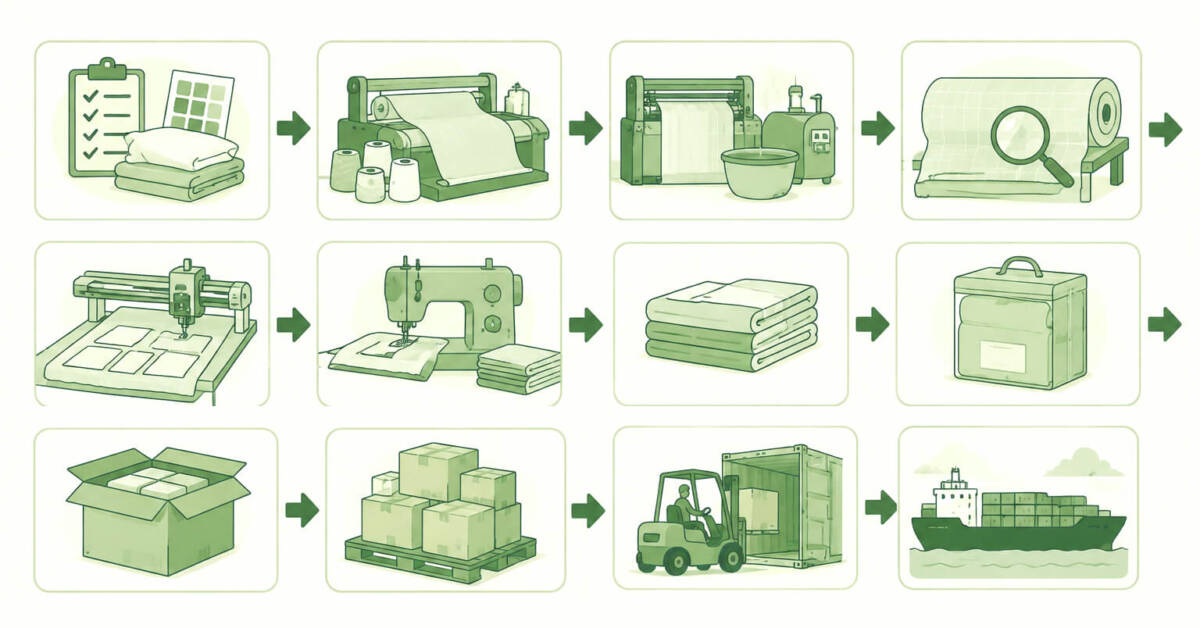
1.Order Confirmation and Pre-Production Preparation
Production doesn’t start with cutting. It starts with confirming the product specifications.
Before production is scheduled, the manufacturer will usually confirm the product combination, fabric composition, yarn count and thread count, weave, finished dimensions, mattress depth, colour or print design, sewing construction, labels, packaging, testing requirements, order quantity and delivery date with the buyer.
For OEM and private-label orders, buyers will also need to provide logo files, care label and main label artwork, packaging artwork, barcodes, SKU information and carton marking requirements. The factory will usually produce a sample first. Once the buyer has approved the fabric, colour, dimensions, workmanship and packaging, the approved sample and specification sheet become the main references for bulk production.
The more thoroughly the specifications are confirmed upfront, the lower the risk of rework, production delays and quality inconsistencies during bulk production.
2.Fabric Weaving and Finishing
Fabric production usually starts with yarn preparation. Based on the order requirements, the appropriate yarn, weave construction and production process are selected before the warp and weft yarns are woven into greige fabric.
Common bedding fabrics include cotton, poly-cotton, polyester microfibre, bamboo viscose and linen blends, while common weaves include percale, twill and sateen. Yarn quality, fabric density and weave construction all influence the hand feel, breathability, durability and appearance of the fabric, so quality should not be judged by thread count alone.
Once the greige fabric has been woven, it goes through finishing processes according to the product requirements. These may include desizing, scouring, bleaching, dyeing or printing, followed by heat setting, pre-shrinking and softening. Solid-colour products are generally dyed, while printed products may use rotary screen printing, flat screen printing or digital printing depending on the complexity of the design, order quantity and cost requirements.
Dyeing and finishing have a direct impact on colour consistency, shrinkage, colour fastness and the final hand feel. Buyers should therefore establish the colour standard before production and agree on the reference for approval, whether that’s a colour swatch, Pantone reference, fabric sample or approved sample.
It’s also worth noting that not every bedding factory handles spinning, weaving and dyeing in-house. This doesn’t necessarily mean quality is harder to control. What matters is whether the factory has clear standards for managing upstream suppliers and carries out consistent quality inspections when fabric arrives.
3.Fabric Inspection and Material Preparation
Once the fabric arrives at the finished-product factory, it needs to go through incoming inspection. This includes checking whether the fabric composition and specifications meet the order requirements, as well as checking colour, fabric width, quantity, surface defects, skewing, shade variation and batch consistency.
For custom colours or branded orders, bulk fabric is compared against the colour or fabric sample approved by the buyer. Some shade variation can occur between different dye lots or production batches, so fabrics need to be managed carefully to avoid using noticeably different shades within the same duvet cover or pillowcase.
Where testing is required, the factory can arrange tests for fibre composition, shrinkage, colour fastness, pH, formaldehyde and restricted azo dyes according to the target market and buyer’s requirements. Testing requirements should match the product material, applicable regulations in the target market and customer specifications. Ideally, the testing standards and sampling plan should be confirmed at the order stage so they can be applied throughout production.
4.Fabric Layout and Cutting
Once the fabric has passed inspection, it moves into spreading, layout and cutting. The factory prepares the cutting plan according to the approved size chart, product construction and order quantity, taking into account finished dimensions, seam allowances, hem sizes and fabric shrinkage.
During cutting, obvious fabric defects also need to be marked or avoided. Cut panels are then sorted by size, colour and SKU to prevent different specifications from being mixed.
For products such as duvet covers and pillowcases that are made from multiple fabric panels, the panels should generally come from the same batch or fabrics with consistent colour, with the grain direction kept consistent. Shrinkage can differ between the warp and weft directions. If panels are cut in different directions, the finished product may twist, distort or become uneven in size after washing.
For fitted sheets, particular attention needs to be paid to mattress length, width and depth, as well as the required tuck-under allowance and elastic construction. Incorrect mattress depth or fitting requirements are common reasons for fitted sheets not fitting properly.
5.Sewing and Workmanship
Once cutting is complete, the individual panels move into sewing.
The sewing process for bedding sets typically includes hemming sheets, joining and closing duvet covers, finishing pillowcase edges, attaching elastic to fitted sheets, fitting zippers or buttons, adding internal ties, sewing labels and trimming loose threads.
Quality control priorities vary between products. For sheets, the focus is on hem width, straight stitching and corner finishing. Duvet covers need to be checked for panel alignment, closure position and the security of zippers or buttons. Pillowcases need consistent dimensions, opening depth and decorative edges, while fitted sheets require the correct elastic tension, corner construction and fit around the mattress.
For hotel linen, wholesale orders and private-label products that require ongoing repeat orders, factories should follow the approved sample and workmanship specification to keep dimensions, colours, trims and sewing methods as consistent as possible between production runs.
6.In-Process and Final Inspection
Quality inspection shouldn’t only take place before packaging. It needs to run throughout the production process.
During production, quality inspectors check cut-panel dimensions, sewing quality, stitch density, hem width, loose threads, stains, damage, shade variation, label positioning, elastic tension and whether accessories such as zippers and buttons meet the required standard. Any issues should be corrected promptly to prevent defective products from moving into the next stage.
Final inspection usually covers appearance, dimensions, workmanship, colour, product combination and functional details. Dimensions should be assessed against the agreed tolerance rather than the nominal size alone. Where required, final inspection can also be carried out according to an agreed sampling plan or by a third-party inspection company appointed by the buyer.
For products sold into markets with stricter foreign-object control requirements, factories should also have broken-needle control procedures in place and arrange needle detection or metal detection where required by the product or customer.
7.Pressing, Folding and Packaging
Once the products have passed inspection, they are pressed or finished as required, then folded and packed according to the buyer’s approved method. Packaging options may include standard poly bags, zipper bags, non-woven bags, paper cards, printed boxes or other custom packaging.
Private-label orders usually also include main labels, care labels, swing tags, inserts, barcode stickers and branded packaging. Before packing, the product name, fabric composition, size, colour, SKU, barcode and packing quantity need to be checked again to make sure the product matches the correct labels, packaging and barcode.
Packaging materials also need to be confirmed in advance. More complex printed boxes, custom fabric bags and printed accessories usually require separate sampling and production, and their lead times can affect the packaging schedule for the entire order.
8.Carton Packing, Warehousing and Shipment Preparation
Once packaging is complete, the products are packed into export cartons according to the agreed packing requirements. The factory needs to check the product specification, colour, quantity, gross weight, net weight, carton number and shipping marks for each carton, and make sure the carton information matches the packing list.
For orders containing mixed sizes, colours or multiple SKUs, accurate sorting and carton marking are particularly important. Incorrect packing information can create problems with receiving, sorting and inventory entry once the goods arrive at the overseas warehouse.
After carton packing, the goods are usually stored in a clean, dry area while waiting for the shipping booking and container loading. Before shipment, the factory or freight forwarder also needs to confirm the container type, loading quantity, container pick-up time, customs documentation and port cut-off time.
9.Container Inspection and Loading
When the container arrives at the factory, it should be checked before loading to make sure it is clean, dry, free from unusual odours, and has no obvious damage or risk of water leakage.
Bedding readily absorbs moisture. If the inside of the container is damp, a long sea journey can result in wet cartons, mouldy packaging or unpleasant odours in the products.
When loading the container, the carton dimensions, weight and available container space need to be considered to achieve a reasonable loading rate without placing excessive pressure on the cartons. The container number, seal number and actual quantity loaded should be recorded during loading. Once loading is complete, the container is sealed and customs clearance and transport are arranged as agreed.
Whether container desiccants, moisture-control materials or other protective measures are required should be determined according to the shipping route, season, destination climate, packaging construction and customer requirements.
10.What Buyers Should Confirm Before Production
To reduce production errors and keep the order on schedule, buyers should confirm at least the following before placing an order: product combination, fabric composition, yarn count and thread count, weave, finished dimensions, mattress depth, colour standard, order quantity, SKU breakdown, logo and label files, packaging method, testing requirements, destination country, Incoterms and target delivery date.
If buyers can provide an existing specification sheet, physical sample, fabric swatch, test report or packaging artwork, the manufacturer can assess production feasibility more quickly and identify any differences between the new order and the existing product more accurately.
Bulk production of bedding sets typically takes around 25 to 45 days after the samples and all production details have been approved and the deposit has been received. Actual lead times will depend on whether the fabric needs to be woven, dyed or printed from scratch, as well as the order quantity, level of customisation, testing requirements, packaging complexity and peak production periods. This production lead time generally does not include international shipping.
Conclusion
Bedding sets may look relatively simple, but consistent bulk production relies on close coordination between specification confirmation, fabric control, cutting accuracy, sewing workmanship, quality inspection, packaging management and container loading.
For overseas wholesalers and brand buyers, choosing a supplier shouldn’t come down to unit price alone. It’s equally important to understand how the factory manages approved samples, production batches, dimensional tolerances, shade variation, inspection standards and packaging data. By turning requirements into clear, workable production standards before placing an order, buyers can significantly reduce the risk of rework, delivery delays and quality disputes after the goods arrive.